
How often should you actually service your AC in Bangalore?
The "once a year" rule is a national average, and Bangalore is not an average city. A schedule based on running hours, dust and the monsoon instead of the calendar.
Servixo Editorial5 min read
Every AC manual and every technician will tell you the same thing: service it once a year. It is not bad advice, but it is advice written for the whole country. An air conditioner in Chennai runs for eight or nine months. One in Bangalore might run hard for fourteen weeks and then sit untouched until the following February. Servicing both on the same schedule means one is neglected and the other is being cleaned for the sake of it.
A more useful question is not how often, but how much has it run, and in what air.
Count running hours, not months
The things that degrade in an air conditioner degrade with use, not with time on the calendar. Filters load up with dust in proportion to the air pushed through them. The evaporator coil fouls when that dust gets past the filter. The drain pan grows biofilm when it is wet, which is when the unit is running.
In most Bangalore homes the AC season is roughly late February to early June, with a second, shorter stretch of humid evenings during the monsoon when people run it to dehumidify rather than to cool. That is a genuinely light duty cycle by Indian standards. It means a well-timed service before the season starts does most of the work, and it means the "twice a year" schedule sold in hotter cities is usually money you do not need to spend here.
What changes that calculation is not the weather but the air:
- A flat on an arterial road or above a construction site. Fine cement dust and road grit will clog a filter in a fortnight of running. This is the single biggest variable in the city.
- A ground-floor or first-floor unit. Outdoor condensers close to the street pick up leaf litter, dust and plastic.
- Pets, or a kitchen that opens into the room the AC is in. Hair and cooking grease both end up on the evaporator, and grease is much harder to remove than dust.
The filter is not the service
This is where most of the money is wasted, in both directions.
Washing the filter is a ten-minute job you should do yourself, and you should do it every two to four weeks while the unit is in daily use — not annually. Slide the front panel up, lift the two mesh filters out, rinse them under a tap from the clean side outwards, let them dry fully in shade, and put them back. A filter that is still damp when it goes in is how a unit starts to smell.
Paying a technician to do only that is paying a visit charge for something that takes no tools. Conversely, having done it yourself does not mean the unit has been serviced. The filter protects the coil; it does not clean it.
A two-minute check
Look at the evaporator fins behind the filter with a torch. If the aluminium looks furred or grey rather than bright, the dust has gone past the filter and a wet service is due — regardless of what the calendar says.
What a real service actually includes
When you book a service, this is the work that justifies the charge. It is worth knowing so you can tell whether you got it:
- Filters removed and washed, and checked for tears — a torn filter is worse than a dirty one, because it lets dust straight onto the coil.
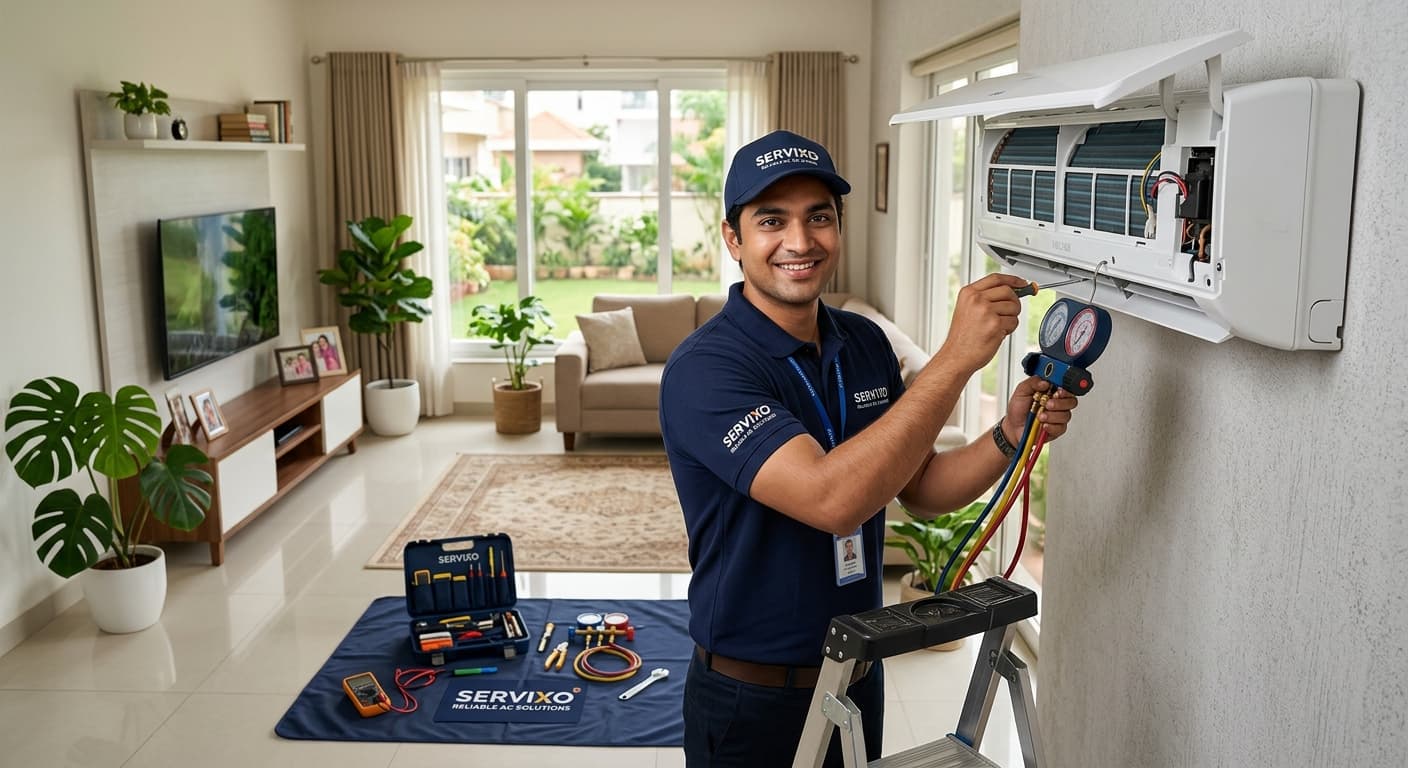
- Evaporator coil cleaned, usually with a foaming coil cleaner and a low-pressure rinse, with the electricals bagged first.
- Blower wheel cleaned. The one most often skipped. The cage behind the coil holds a surprising amount of compacted dust, and a loaded blower moves noticeably less air.
- Drain pan and drain line flushed. Algae and slime in the drain line is the reason indoor units drip onto the wall.
- Outdoor condenser coil washed and cleared of leaves.
- Electrical check — terminals tightened, capacitor and contactor inspected, current draw compared against the rating plate.
- Operating pressures and temperature split measured, which is how anyone knows whether the refrigerant charge is actually correct.
A visit that is a filter wash and a spray of air freshener is not a service, and you can tell the difference by whether the technician opened the outdoor unit at all.
The gas top-up you almost certainly do not need
A split AC is a sealed system. It does not consume refrigerant the way a car consumes fuel. If the charge is low, gas has escaped, and it escaped through a leak that is still there.
So a technician who tops up your gas every year without finding and fixing a leak is selling you the same gas repeatedly. The correct sequence is: measure the pressures and the temperature split, and if the charge is low, find the leak, repair it, evacuate the system, and then recharge by weight. That is a longer and more expensive visit than a top-up, and it is the one that ends the problem.
Annual "gas charging" offered as a routine line item is the clearest signal that you are being upsold.
Signs you have left it too long
- The room takes noticeably longer to reach the set temperature than it did last season.
- Ice forming on the copper pipework or on the coil itself — almost always restricted airflow, occasionally low charge.
- Water dripping from the indoor unit onto the wall. Blocked drain line.
- A musty smell for the first few minutes after startup. Biofilm in the drain pan.
- The unit trips the breaker, or the outdoor fan struggles to start.
A schedule that works for most Bangalore homes
- Filters: every two to four weeks while it is running. Yourself.
- Full service: once a year, in January or February, before the season rather than during it. Availability is better and you find a fault before you need the unit, not on the first 34-degree afternoon.
- Second service: only if the unit runs through the monsoon for dehumidification, or if it is in dusty air — then a mid-season coil clean around June is worth it.
- Off-season: if the AC sits unused from July to January, run it for fifteen to twenty minutes once a month. It keeps the compressor's oil moving and the seals from drying out.
Before you book
Note the make, the tonnage, whether it is inverter or fixed-speed, and when it was last serviced. Ask what the quoted price covers, and specifically whether it includes the outdoor unit and a drain line flush, because those are the two things most often left out of a cheap quote. If the unit is more than eight years old and needs a gas leak repair, ask what the repair costs against a replacement before agreeing to it.
If you would rather have someone else do the annual one, you can book an AC service and describe the symptoms above when you do — the more specific you are, the more likely the right parts arrive with the technician.
More reading
Other guides
 Cleaning
What deep cleaning actually covers, and what it doesn't
Most disappointment with a deep clean comes from a mismatch about scope, not from bad work. What is standard, what is usually an extra, and what no cleaning can fix.
 Plumbing
Seven plumbing problems worth fixing before the monsoon
Every one of these is cheap and boring in April and expensive in July. What to check on the terrace, in the bathrooms and around the tank before the rain arrives.
Ready when you are
Book a service in under a minute, or register as a Service Provider and start taking work in your area.